
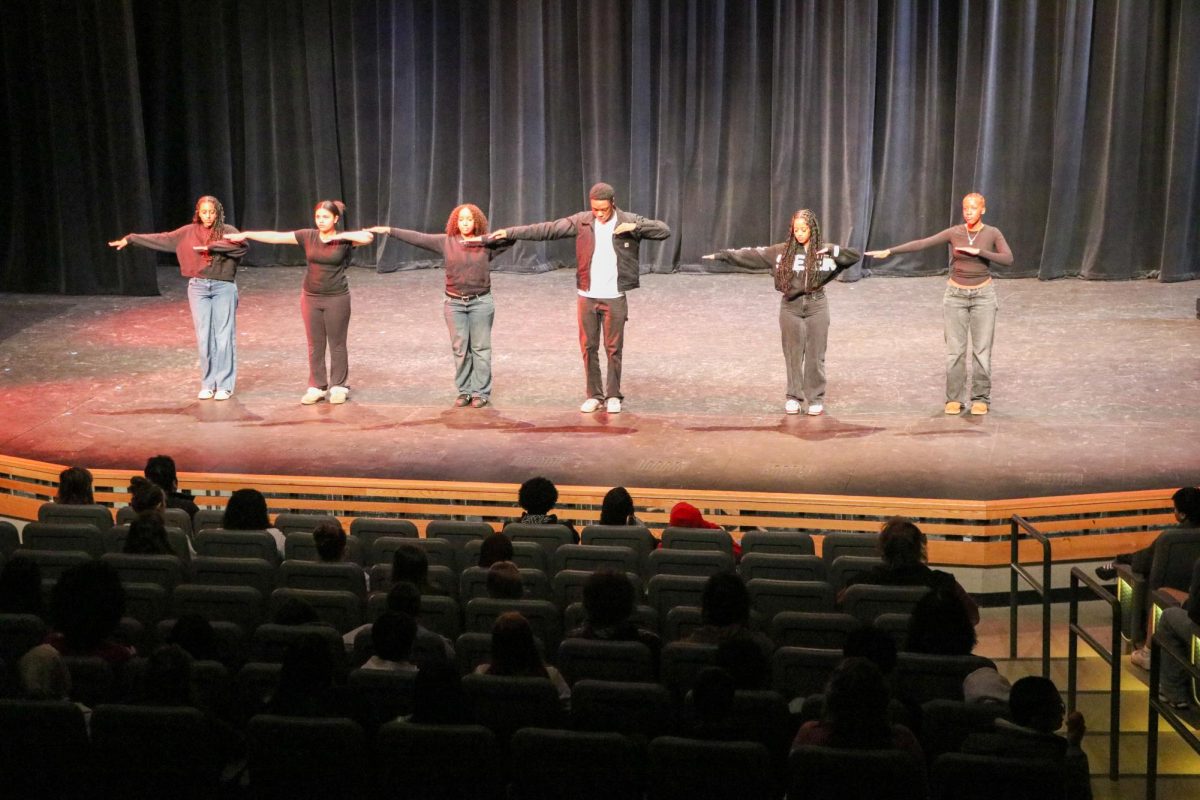
Clickity-clack-clack. Bright lights blur the faces of the students in the crowd, the rhythmic stomping of feet against the stage echoing throughout the room. The crowd is silent, captivated by the performance.
This is the experience of a performer on the step team in the Black History Month Assembly.
This assembly is one rich with expression and education, occurring every year in February here at Shorewood.
The organizing that goes into putting it together takes lots of time, with preparations starting months in advance, and brainstorming starting all the way at the beginning of the year.
All of this is set in motion by the Black Student Union (BSU) club. Senior Rhodas Esayas is one of the leaders of both BSU itself and the production of the Black History Month (BHM) Assembly.
We [first] create the script, and then we give it to the members and we work with speaking practice and everything like that,” Esayas said. “With the scripts, and behind the scenes, it’s the leaders thinking and getting information on the ideas of what the script will be about.”
As a community-led effort, students are given an opportunity to contribute their ideas to the assembly.
The scripts are different each year, as they’re based around different overarching themes. These themes are typically narrowed down to parts of history.
This year, the theme is the effects of the African diaspora.
“We’re incorporating the slave trade, [and] different parts are on the… multicultural communities that were created in places that [enslaved people] were transported to, and the social effect, and the different racial groups that they created,” said junior Semira Woldu, another leader of the BSU club.
Not only is preparation important in speaking roles, but also in the unique step dance that’s featured. This dance is put on by the step team, who performs a new routine each year.
Although the step group is a part of the Black Student Union, it’s a slightly separate entity, as they don’t do all of the same things that BSU does.
However, it still falls under the BSU umbrella because it hasn’t been made into an official performance team yet.
This group of students practices multiple times a week, especially as the assembly nears, working to memorize the choreography and put it all together.
Junior Zayllens Tambwe is one of the co-leaders of the team and, along with a few other students, helps teach the choreography to the rest of the performers.
He and the rest of the leaders will typically search online for pre-made routines and learn them within a week, before beginning to teach the rest of the team.
“For the entire group, [learning the routine] could take up to a month,” Tambwe said.
Further than simply memorization, the team has to sort out all of the precise parts of performing – how they’re going to share the stage with one another, the walk-on, walk-off, and all of the spatial necessities.
Although the BHM Assembly is a big moment for the step team, it is not their only performance of the year – they perform at other schools as well, such as Jackson High School and various elementary schools.
Much of the assembly is attributed to student-driven efforts, which makes it all the more interesting and engaging to see. “It’s completely student-run; we write the script, we make the slideshow, we organize all of the time and everything,” Woldu said.
While this load can easily become stressful, it’s also an exciting opportunity to be putting together such a unique learning experience for the school to see.
“I feel like it’s something we look forward to because a lot of hard work goes into it, and it’s something that’s fun and expressive,” said Esayas.
“It’s definitely one of my favorite events of the year,” Woldu said. “I think it’s really important to educate others on Black history, and why it’s important, and different aspects of Black culture… I feel like when you’re learning it in a history class, versus when you’re learning it in the assembly by students like you; it’s very different.”